This page has been machine-translated from the original page.
I participated in TetCTF, which started on 1/27, as a solo player.
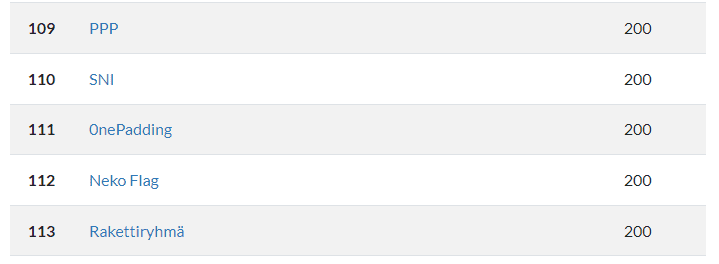
I only managed to solve one Rev challenge, but it seems this CTF was fairly difficult, and I ended up in 111th place.
Still, the top scores looked like this, so the gap felt pretty daunting.
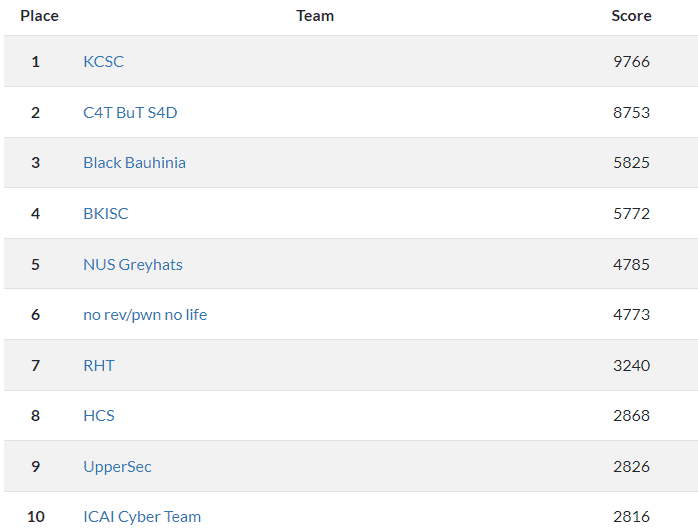
Table of Contents
babyasm(Rev)
Description:
Can you unlock it?
When you access the URL given in the problem statement, you can see that it runs a service that accepts input and validates it using logic implemented in WebAssembly.
<!DOCTYPE html>
<html lang="en">
<head>
  <meta charset="UTF-8">
  <meta name="viewport" content="width=device-width, initial-scale=1.0">
  <title>baby-asm</title>
  <style>
    body {
      font-family: 'Courier New', monospace;
      margin: 0;
      padding: 0;
      background-color: #f0f0f0;
      display: flex;
      flex-direction: column;
      height: 100vh;
    }
    #console {
      flex-grow: 1;
      width: 100%;
      overflow: auto;
      background-color: black;
      color: white;
      padding: 10px;
      box-sizing: border-box;
    }
    #input {
      width: 100%;
      padding: 5px;
      box-sizing: border-box;
    }
  </style>
</head>
<body>
  <div id="console"></div>
  <input type="text" id="input" placeholder="Input your password">

  <script>

    code = [ 0,97,115,109,1,0,0,0,1,56,9,80,0,95,1,127,1,80,0,94,99,0,1,96,0,0,96,1,127,1,100,1,96,3,99,1,127,127,0,96,2,99,1,127,1,127,96,4,99,1,127,127,127,0,96,1,99,1,1,127,96,1,99,1,1,127,3,8,7,2,3,4,5,6,7,8,6,118,20,127,1,65,224,0,11,127,1,65,229,0,11,127,1,65,20,11,127,1,65,177,1,11,127,1,65,155,1,11,127,1,65,244,0,11,127,1,65,236,0,11,127,1,65,197,0,11,127,1,65,212,0,11,127,1,65,237,0,11,127,1,65,231,0,11,127,1,65,238,0,11,127,1,65,239,0,11,127,1,65,223,0,11,127,1,65,244,0,11,127,1,65,231,0,11,127,1,65,225,0,11,127,1,65,200,0,11,127,1,65,20,11,127,1,65,59,11,7,45,7,1,49,0,0,4,105,110,105,116,0,1,10,97,114,114,97,121,95,102,105,108,108,0,2,1,51,0,3,1,52,0,4,1,53,0,5,5,99,104,101,99,107,0,6,10,184,8,7,142,1,0,35,0,65,19,115,36,0,35,1,65,55,115,36,1,35,2,65,32,115,36,2,35,3,65,36,115,36,3,35,4,65,19,115,36,4,35,5,65,55,115,36,5,35,6,65,32,115,36,6,35,7,65,36,115,36,7,35,8,65,19,115,36,8,35,9,65,55,115,36,9,35,10,65,32,115,36,10,35,11,65,36,115,36,11,35,12,65,19,115,36,12,35,13,65,55,115,36,13,35,14,65,32,115,36,14,35,15,65,36,115,36,15,35,16,65,19,115,36,16,35,17,65,55,115,36,17,35,18,65,32,115,36,18,35,19,65,36,115,36,19,11,9,0,32,0,251,7,1,16,0,11,22,0,32,0,32,1,32,2,65,19,106,65,64,107,251,0,0,65,1,251,16,1,11,13,0,32,0,32,1,251,11,1,251,2,0,0,11,109,0,32,1,65,0,70,4,64,32,0,32,2,32,0,32,2,16,3,32,3,106,65,32,115,16,2,5,32,1,65,1,70,4,64,32,0,32,2,32,0,32,2,16,3,32,3,106,65,36,115,16,2,5,32,1,65,2,70,4,64,32,0,32,2,32,0,32,2,16,3,32,3,106,65,19,115,16,2,5,32,1,65,3,70,4,64,32,0,32,2,32,0,32,2,16,3,32,3,106,65,55,115,16,2,11,11,11,11,11,172,3,1,1,127,32,0,65,0,16,3,65,137,175,2,70,4,64,32,1,65,1,106,33,1,5,11,32,0,65,1,16,3,65,200,4,70,4,64,32,1,65,1,106,33,1,11,32,0,65,2,16,3,65,226,5,70,4,64,32,1,65,1,106,33,1,11,32,0,65,3,16,3,65,194,173,2,70,4,64,32,1,65,1,106,33,1,11,32,0,65,4,16,3,65,193,242,3,70,4,64,32,1,65,1,106,33,1,11,32,0,65,5,16,3,65,135,5,70,4,64,32,1,65,1,106,33,1,11,32,0,65,6,16,3,65,193,6,70,4,64,32,1,65,1,106,33,1,11,32,0,65,7,16,3,65,242,240,3,70,4,64,32,1,65,1,106,33,1,11,32,0,65,8,16,3,65,166,243,2,70,4,64,32,1,65,1,106,33,1,11,32,0,65,9,16,3,65,238,3,70,4,64,32,1,65,1,106,33,1,11,32,0,65,10,16,3,65,151,5,70,4,64,32,1,65,1,106,33,1,11,32,0,65,11,16,3,65,229,241,2,70,4,64,32,1,65,1,106,33,1,11,32,0,65,12,16,3,65,225,139,4,70,4,64,32,1,65,1,106,33,1,11,32,0,65,13,16,3,65,129,5,70,4,64,32,1,65,1,106,33,1,11,32,0,65,14,16,3,65,151,6,70,4,64,32,1,65,1,106,33,1,11,32,0,65,15,16,3,65,174,137,4,70,4,64,32,1,65,1,106,33,1,11,32,0,65,16,16,3,65,225,149,2,70,4,64,32,1,65,1,106,33,1,11,32,0,65,17,16,3,65,177,4,70,4,64,32,1,65,1,106,33,1,11,32,0,65,18,16,3,65,161,5,70,4,64,32,1,65,1,106,33,1,11,32,0,65,19,16,3,65,234,147,2,70,4,64,32,1,65,1,106,33,1,11,32,1,65,20,70,4,127,65,1,5,65,0,11,11,218,2,0,32,0,65,0,65,1,32,0,65,0,16,3,35,0,106,16,4,32,0,65,1,65,2,32,0,65,1,16,3,35,1,107,16,4,32,0,65,2,65,3,32,0,65,2,16,3,35,2,108,16,4,32,0,65,3,65,0,32,0,65,3,16,3,35,3,115,16,4,32,0,65,0,65,5,32,0,65,4,16,3,35,4,106,16,4,32,0,65,1,65,6,32,0,65,5,16,3,35,5,107,16,4,32,0,65,2,65,7,32,0,65,6,16,3,35,6,108,16,4,32,0,65,3,65,4,32,0,65,7,16,3,35,7,115,16,4,32,0,65,0,65,9,32,0,65,8,16,3,35,8,106,16,4,32,0,65,1,65,10,32,0,65,9,16,3,35,9,107,16,4,32,0,65,2,65,11,32,0,65,10,16,3,35,10,108,16,4,32,0,65,3,65,8,32,0,65,11,16,3,35,11,115,16,4,32,0,65,0,65,13,32,0,65,12,16,3,35,12,106,16,4,32,0,65,1,65,14,32,0,65,13,16,3,35,13,107,16,4,32,0,65,2,65,15,32,0,65,14,16,3,35,14,108,16,4,32,0,65,3,65,12,32,0,65,15,16,3,35,15,115,16,4,32,0,65,0,65,17,32,0,65,16,16,3,35,16,106,16,4,32,0,65,1,65,18,32,0,65,17,16,3,35,17,107,16,4,32,0,65,2,65,19,32,0,65,18,16,3,35,18,108,16,4,32,0,65,3,65,16,32,0,65,19,16,3,35,19,115,16,4,32,0,16,5,11,0,45,4,110,97,109,101,1,38,7,0,1,49,1,4,105,110,105,116,2,10,97,114,114,97,121,95,102,105,108,108,3,1,51,4,1,52,5,1,53,6,5,99,104,101,99,107 ];            const byte_code = new Uint8Array(code);

    const wasmModule = new WebAssembly.Module(byte_code);
    const wasmInstance = new WebAssembly.Instance(wasmModule, {});
    const wasm = wasmInstance.exports;

    const consoleDiv = document.getElementById('console');
    const inputField = document.getElementById('input');

    inputField.addEventListener('keydown', function (event) {
      if (event.key === 'Enter') {
        const inputText = inputField.value;
        processInput(inputText);
        inputField.value = '';
      }
    });

    function processInput(text) {
      const p = document.createElement('p');
      if (text.startsWith('TetCTF{') && text.endsWith('}') && text.length === 27) {

        let array_size= 20;
        let array_obj = wasm.init(array_size);

        for (var i = 0; i < array_size; i++) {
          wasm.array_fill(array_obj, i, text.charCodeAt(i+7));
        }
        if (wasm.check(array_obj )){
          p.textContent = '> Correct!';
        } else {
          p.textContent = '> Incorrect!';
        }
      } else {
        p.textContent = '> Incorrect!';
      }
      consoleDiv.appendChild(p);
      consoleDiv.scrollTop = consoleDiv.scrollHeight;
    }
  </script>
</body>
</html>
The webpage looked like this.

As a first step, I saved the byte sequence hardcoded in the HTML as a .wasm file so I could decompile the WebAssembly.
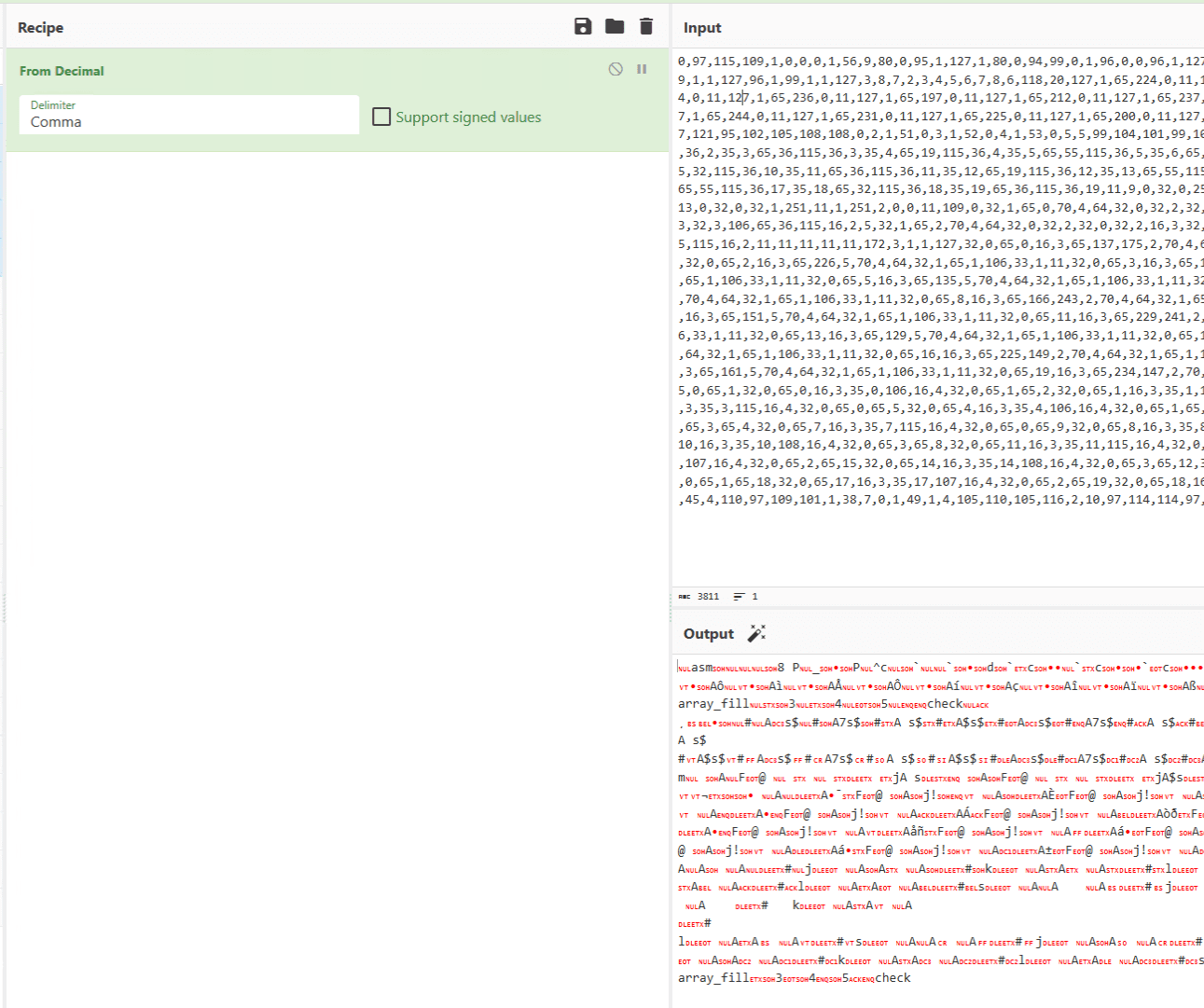
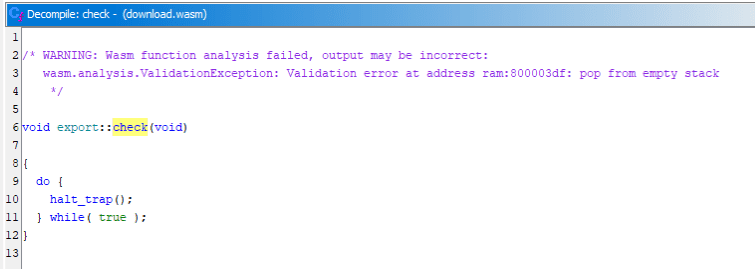
However, I couldn’t analyze it properly with wabt, so I had no choice but to read the assembly code shown in the browser instead.
For reference, Ghidra with the Wasm plugin installed also failed to decompile it.
As you can see from the JavaScript implementation, the input string is first checked to see whether it is a 27-character text matching the flag format TetCTF{.*}. After initialization with wasm.init(array_size) and wasm.array_fill(array_obj, i, text.charCodeAt(i+7));, validation is then performed by wasm.check(array_obj).
function processInput(text) {
  const p = document.createElement('p');
  if (text.startsWith('TetCTF{') && text.endsWith('}') && text.length === 27) {

    let array_size= 20;
    let array_obj = wasm.init(array_size);

    for (var i = 0; i < array_size; i++) {
      wasm.array_fill(array_obj, i, text.charCodeAt(i+7));
    }
    if (wasm.check(array_obj )){
      p.textContent = '> Correct!';
    } else {
      p.textContent = '> Incorrect!';
    }
  } else {
    p.textContent = '> Incorrect!';
  }
  consoleDiv.appendChild(p);
  consoleDiv.scrollTop = consoleDiv.scrollHeight;
}
The wasm.array_fill() function was implemented as follows.
Here, it stores at a specific index of the array given as the first argument the value obtained by adding 83 to the value received as the third argument.
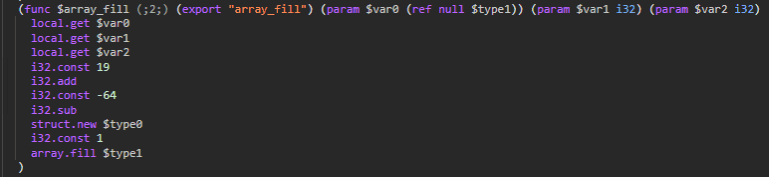
In Python, this looks like the following.
# array_fill
def array_fill(arr,i,c):
    arr[i] = c + 83
    return arr
The check function called afterward performs the following processing.
(func $check (;6;) (export "check") (param $var0 (ref null $type1)) (result i32)
    local.get $var0
    i32.const 0
    i32.const 1
    local.get $var0
    i32.const 0
    call $3
    global.get $global0
    i32.add
    call $4
    local.get $var0
    i32.const 1
    i32.const 2
    local.get $var0
    i32.const 1
    call $3
    global.get $global1
    i32.sub
    call $4
    local.get $var0
    i32.const 2
    i32.const 3
    local.get $var0
    i32.const 2
    call $3
    global.get $global2
    i32.mul
    call $4
    local.get $var0
    i32.const 3
    i32.const 0
    local.get $var0
    i32.const 3
    call $3
    global.get $global3
    i32.xor
    call $4
    local.get $var0
    i32.const 0
    i32.const 5
    local.get $var0
    i32.const 4
    call $3
    global.get $global4
    i32.add
    call $4
    local.get $var0
    i32.const 1
    i32.const 6
    local.get $var0
    i32.const 5
    call $3
    global.get $global5
    i32.sub
    call $4
    local.get $var0
    i32.const 2
    i32.const 7
    local.get $var0
    i32.const 6
    call $3
    global.get $global6
    i32.mul
    call $4
    local.get $var0
    i32.const 3
    i32.const 4
    local.get $var0
    i32.const 7
    call $3
    global.get $global7
    i32.xor
    call $4
    local.get $var0
    i32.const 0
    i32.const 9
    local.get $var0
    i32.const 8
    call $3
    global.get $global8
    i32.add
    call $4
    local.get $var0
    i32.const 1
    i32.const 10
    local.get $var0
    i32.const 9
    call $3
    global.get $global9
    i32.sub
    call $4
    local.get $var0
    i32.const 2
    i32.const 11
    local.get $var0
    i32.const 10
    call $3
    global.get $global10
    i32.mul
    call $4
    local.get $var0
    i32.const 3
    i32.const 8
    local.get $var0
    i32.const 11
    call $3
    global.get $global11
    i32.xor
    call $4
    local.get $var0
    i32.const 0
    i32.const 13
    local.get $var0
    i32.const 12
    call $3
    global.get $global12
    i32.add
    call $4
    local.get $var0
    i32.const 1
    i32.const 14
    local.get $var0
    i32.const 13
    call $3
    global.get $global13
    i32.sub
    call $4
    local.get $var0
    i32.const 2
    i32.const 15
    local.get $var0
    i32.const 14
    call $3
    global.get $global14
    i32.mul
    call $4
    local.get $var0
    i32.const 3
    i32.const 12
    local.get $var0
    i32.const 15
    call $3
    global.get $global15
    i32.xor
    call $4
    local.get $var0
    i32.const 0
    i32.const 17
    local.get $var0
    i32.const 16
    call $3
    global.get $global16
    i32.add
    call $4
    local.get $var0
    i32.const 1
    i32.const 18
    local.get $var0
    i32.const 17
    call $3
    global.get $global17
    i32.sub
    call $4
    local.get $var0
    i32.const 2
    i32.const 19
    local.get $var0
    i32.const 18
    call $3
    global.get $global18
    i32.mul
    call $4
    local.get $var0
    i32.const 3
    i32.const 16
    local.get $var0
    i32.const 19
    call $3
    global.get $global19
    i32.xor
    call $4
    local.get $var0
    call $5
  )
)
Within it, the following sequence is executed for 20 characters.
- Use function
$3to retrieve the value corresponding to an index from the array. - Add, subtract, multiply, or XOR the retrieved value with the value defined in a global variable.
-
Call function
$4to update a value in the array.=> When
param_1is 0- Add the original value and the global value, XOR the result with 32, then add 83 via
array_fill, and use that to update the array element specified byvar2.
=> When
param_1is 1- Subtract the global value from the original value, XOR the result with 36, then add 83 via
array_fill, and use that to update the array element specified byvar2.
=> When
param_1is 2- Multiply the original value by the global value, XOR the result with 19, then add 83 via
array_fill, and use that to update the array element specified byvar2.
=> When
param_1is 3- XOR the original value with the global value, XOR the result with 55, then add 83 via
array_fill, and use that to update the array element specified byvar2.
- Add the original value and the global value, XOR the result with 32, then add 83 via
- Finally, function
$5checks whether the resulting array matches the hardcoded values.
After rewriting these processes as a Python script and using Z3, I identified the correct flag.
from z3 import *
from math import *

flag = [BitVec(f"flag[{i}]", 8) for i in range(27)]
s = Solver()

# TetCTF{AAAAAAAAAAAAAAAAAAA}
s.add(flag[0] == ord("T"))
s.add(flag[1] == ord("e"))
s.add(flag[2] == ord("t"))
s.add(flag[3] == ord("C"))
s.add(flag[4] == ord("T"))
s.add(flag[5] == ord("F"))
s.add(flag[6] == ord("{"))
s.add(flag[26] == ord("}"))
for i in range(7,26):
    s.add(And(
        (flag[i] >= 0x21),
        (flag[i] <= 0x7e)
    ))

# flag = list("TetCTF{") + [ord("A") for i in range(20)] + ["}"]

globals = [115,82,52,149,136,67,76,97,71,90,71,74,124,104,84,67,114,127,52,31]

# array_fill
def array_fill(arr,i,c):
    arr[i] = c + 83
    return arr

def f4(arr,type_num,index,value):
    tmp = arr[index] + value

    if type_num == 0:
        tmp = tmp ^ 32
    if type_num == 1:
        tmp = tmp ^ 36
    if type_num == 2:
        tmp = tmp ^ 19
    if type_num == 3:
        tmp = tmp ^ 55

    arr = array_fill(arr,index,tmp)
    return arr

arr = [0 for i in range(20)]
for i in range(20):
    arr = array_fill(arr,i,flag[i+7])

# print(arr)
next = [1,2,3,0,5,6,7,4,9,10,11,8,13,14,15,12,17,18,19,16]

for i in range(20):
    type_num = i % 4
    index = next[i]
    val = arr[i]
    g_val = globals[i]

    if type_num == 0:
        val = val + g_val
    if type_num == 1:
        val = val - g_val
    if type_num == 2:
        val = val * g_val
    if type_num == 3:
        val = val ^ g_val

    # print(type_num,index,val)
    arr = f4(arr,type_num,index,val)

# print(arr)

ans = [38793,584,738,38594,63809,647,833,63602,47526,494,663,47333,67041,641,791,66734,35553,561,673,35306]
for i in range(20):
    s.add(ans[i] == arr[i])

assert s.check() == sat
while s.check() == sat:
    m = s.model()
    for c in flag:
        print(chr(m[c].as_long()),end="")
    print("")
    break
Running this solver shows that the correct flag is TetCTF{WebAss3mblyMystique}.
Warm up(Rev)
Here’s a warm-up challenge that might just have a few surprises up its sleeve. Grab your tools and ready your Python scripts. It’s a bit tricky, but that’s part of the fun. Happy reversing! Password: c769662da57fe94b68cc08fb6d99ffc6
When I decompiled the ELF file provided as the challenge binary with Ghidra, I found that it validates the input taken from standard input with the check_key function.
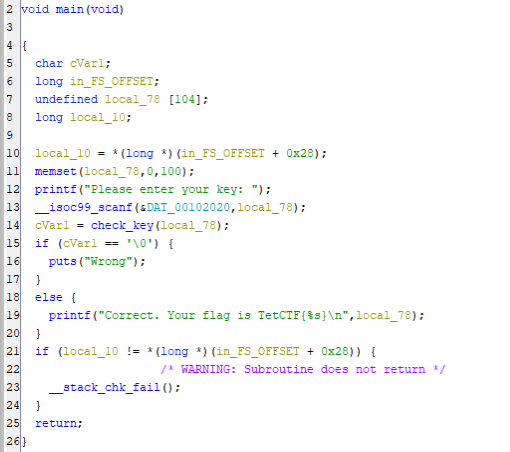
The decompiled output of this function looked like the following.
undefined8 check_key(char *param_1)
{
  long lVar1;
  int iVar2;
  size_t len_flag;
  undefined8 uVar3;
  long in_FS_OFFSET;
  uint k;
  uint m;
  uint l;
  uint a;
  uint b;
  uint i;
  long mem1 [22];
  long mem2 [22];
  long unk [22];
  undefined8 local_38;
  undefined8 local_30;
  undefined4 local_28;
  undefined2 local_24;
  long local_20;

  local_20 = *(long *)(in_FS_OFFSET + 0x28);
  len_flag = strlen(param_1);
  if (len_flag == 0x54) {
    local_38 = 0x6766656463615f21;
    local_30 = 0x72706f6e6d6c6968;
    local_28 = 0x77757473;
    local_24 = 0x79;
    for (k = 0; k < 0x54; k = k + 1) {
      for (m = 0; (m < 0x15 && (*(char *)((long)&local_38 + (ulong)m) != param_1[k])); m = m + 1) {
        if (m == 0x14) {
          uVar3 = 0;
          goto LAB_00101603;
        }
      }
    }
    memset(mem1,0,0xa8);
    for (l = 0; l < 0x15; l = l + 1) {
      iVar2 = hash_64_fnv1a(param_1 + (l << 2),4);
      mem1[l] = (long)iVar2;
    }
    x = 0x75bcd15;
    y = 0x159a55e5;
    z = 0x1f123bb5;
    w = 0xdeadbeef;
    memset(mem2,0,0xa8);
    for (a = 0; a < 0x15; a = a + 1) {
      for (b = 0; b < 0x15; b = b + 1) {
        lVar1 = mem1[b];
        iVar2 = xorshift128();
        mem2[a] = lVar1 * (iVar2 % 0x400) + mem2[a];
      }
    }
    unk[0] = -0x90ee47fcb5;
    unk[1] = 0x673420daf2;
    unk[2] = 0x45eb817f02c;
    unk[3] = 0xfffffe3099503945;
    unk[4] = 0x18f8dce1227;
    unk[5] = 0x26050ea6875;
    unk[6] = 0x298599c4bf0;
    unk[7] = 0xfffff8a356ce9e58;
    unk[8] = 0xfffffed3c712cf36;
    unk[9] = 0xfffffe96846d630f;
    unk[10] = 0x58cb1ce3ff3;
    unk[11] = 0xfffffccf182c2a63;
    unk[12] = 0xfffffe57fdf3f1de;
    unk[13] = 0xfffffa603f35f962;
    unk[14] = 0xffffff7884570b57;
    unk[15] = 0x4897c4d9c1;
    unk[16] = 0xfffffeb9355e5cb4;
    unk[17] = 0xdcedf7d094;
    unk[18] = 0x3602e9cac47;
    unk[19] = 0xfffffee3667219d6;
    unk[20] = 0xfffffdc326c9b063;
    for (i = 0; i < 0x15; i = i + 1) {
      if (unk[i] != mem2[i]) {
        uVar3 = 0;
        goto LAB_00101603;
      }
    }
    uVar3 = 1;
  }
  else {
    uVar3 = 0;
  }
LAB_00101603:
  if (local_20 == *(long *)(in_FS_OFFSET + 0x28)) {
    return uVar3;
  }
                    /* WARNING: Subroutine does not return */
  __stack_chk_fail();
}
This function can also be broken down into several steps.
First, it compares against 0x15 pre-defined characters.
  len_flag = strlen(param_1);
  if (len_flag == 0x54) {
    # 0x21,0x5F,0x61,0x63,0x64,0x65,0x66,0x67,0x68,0x69,0x6C,0x6D,0x6E,0x6F,0x70,0x72,0x73,0x74,0x75,0x77,0x79
    # !_acdefghilmnoprstuwy
    local_38 = 0x6766656463615f21;
    local_30 = 0x72706f6e6d6c6968;
    local_28 = 0x77757473;
    local_24 = 0x79;
    for (k = 0; k < 0x54; k = k + 1) {
      for (m = 0; (m < 0x15 && (*(char *)((long)&local_38 + (ulong)m) != param_1[k])); m = m + 1) {
        if (m == 0x14) {
          uVar3 = 0;
          goto LAB_00101603;
        }
      }
    }
I misread this part a bit during the contest, but what it is actually checking here is that every one of the 0x54 characters in the correct flag string is one of these 0x15 characters.
In the next step, it uses a function called hash_64_fnv1a to convert the 0x54-character flag string into 8-byte hashes, four characters at a time.
memset(mem1,0,0xa8);
for (l = 0; l < 0x15; l = l + 1) {
  iVar2 = hash_64_fnv1a(param_1 + (l << 2),4);
  mem1[l] = (long)iVar2;
}
In the next step, it updates the data in the mem2 region using the 8-byte value obtained from xorshift128, reduced modulo 0x400, together with the hash produced by hash_64_fnv1a.
x = 0x75bcd15;
y = 0x159a55e5;
z = 0x1f123bb5;
w = 0xdeadbeef;
memset(mem2,0,0xa8);
for (a = 0; a < 0x15; a = a + 1) {
  for (b = 0; b < 0x15; b = b + 1) {
    lVar1 = mem1[b];
    iVar2 = xorshift128();
    mem2[a] = lVar1 * (iVar2 % 0x400) + mem2[a];
  }
}
This data is compared against hardcoded values in the final step, and if all values match, the validation passes and the input is accepted as the correct flag.
for (i = 0; i < 0x15; i = i + 1) {
  if (unk[i] != mem2[i]) {
    uVar3 = 0;
    goto LAB_00101603;
  }
}
uVar3 = 1;
Also, the xorshift128 function is implemented as follows.
uint xorshift128(void)
{
  uint uVar1;

  uVar1 = x ^ x << 0xb;
  x = y;
  y = z;
  z = w;
  w = w ^ w >> 0x13 ^ uVar1 ^ uVar1 >> 8;
  return w;
}
Since the initial values of x, y, z, and w used as the seed are hardcoded here, the output of xorshift128 is fixed.
During the contest, I tried various ways to recover the flag with Z3, but I apparently mishandled the underlying byte values and never managed to obtain the flag.
However, if you look closely at the implementation, the output of xorshift128, whose seed is explicit, can be computed as a fixed value.
Also, the mem2 update performed by mem2[a] = lVar1 * (iVar2 % 0x400) + mem2[a]; can be solved as a system of 21 simultaneous equations in which the hashes (lVar1) obtained for each 4-character chunk of the flag string are the terms.
So in the end, by using the following solver, I was able to determine that the correct flag was TetCTF{may_the_lanterns_of_the_lunar_new_year_light_up_your_path_to_success_and_happiness!!}.
from ctypes import *
import numpy as np
import math
from itertools import permutations,product

ans = [0 for i in range(0x15)]
ans[0] = 0xffffff6f11b8034b
ans[1] = 0x673420daf2
ans[2] = 0x45eb817f02c
ans[3] = 0xfffffe3099503945
ans[4] = 0x18f8dce1227
ans[5] = 0x26050ea6875
ans[6] = 0x298599c4bf0
ans[7] = 0xfffff8a356ce9e58
ans[8] = 0xfffffed3c712cf36
ans[9] = 0xfffffe96846d630f
ans[10] = 0x58cb1ce3ff3
ans[11] = 0xfffffccf182c2a63
ans[12] = 0xfffffe57fdf3f1de
ans[13] = 0xfffffa603f35f962
ans[14] = 0xffffff7884570b57
ans[15] = 0x4897c4d9c1
ans[16] = 0xfffffeb9355e5cb4
ans[17] = 0xdcedf7d094
ans[18] = 0x3602e9cac47
ans[19] = 0xfffffee3667219d6
ans[20] = 0xfffffdc326c9b063

def hash_64_fnv1a(data):
    fnv_prime = 0x100000001b3
    hash = 0xcbf29ce484222325
    for byte in data:
        hash = c_int32((hash ^ byte) * fnv_prime).value
    return hash

x = 0x75bcd15
y = 0x159a55e5
z = 0x1f123bb5
w = 0xdeadbeef

def xorshift128():
    global x, y, z, w
    v1 = ((c_uint32(x<<11).value ^ c_uint32(x).value) >> 8)
    v1 ^= c_uint32(x<<11).value ^ x
    v1 = c_uint32(v1).value
    x = y
    y = z
    z = w
    w ^= c_uint32(w).value >> 19
    w ^= v1
    w = c_int32(w).value
    return w

hashes = {}
words = "!_acdefghilmnoprstuwy"
for chars in product(words,repeat=4):
    A = ''.join(chars)
    hashes[hash_64_fnv1a(A.encode())] = A


X = []
for i in range(0x15):
    X.append([int(math.fmod(xorshift128(), 1024)) for n in range(0x15)])

# N1 = val[0]*X[i*0x15+0] + 0
# N2 = val[1]*X[i*0x15+1] + N1
# N3 = val[2]*X[i*0x15+2] + N2
# N4 = val[3]*X[i*0x15+3] + N3
# N5 = val[4]*X[i*0x15+4] + N4
# N6 = val[5]*X[i*0x15+5] + N5
# N7 = val[6]*X[i*0x15+6] + N6
# N8 = val[7]*X[i*0x15+7] + N7
# N9 = val[8]*X[i*0x15+8] + N8
# N10 = val[9]*X[i*0x15+9] + N9
# N11 = val[10]*X[i*0x15+10] + N10
# N12 = val[11]*X[i*0x15+11] + N11
# N13 = val[12]*X[i*0x15+12] + N12
# N14 = val[13]*X[i*0x15+13] + N13
# N15 = val[14]*X[i*0x15+14] + N14
# N16 = val[15]*X[i*0x15+15] + N15
# N17 = val[16]*X[i*0x15+16] + N16
# N18 = val[17]*X[i*0x15+17] + N17
# N19 = val[18]*X[i*0x15+18] + N18
# N20 = val[19]*X[i*0x15+19] + N19
# N21 = val[20]*X[i*0x15+20] + N20
# ans が右辺ベクトル、X[i*0x15+j] が係数行列になるので上記の連立方程式を解く

A = np.array(X)
B = np.array([c_int64(n).value for n in ans])
solution = np.linalg.solve(A, B)

for s in solution:
    v = c_int64(round(s)).value
    print(hashes[v],end="")
Looking back, one clear mistake was that I only thought about blindly throwing the problem into Z3, and failed to notice that the structure could be solved as a system of simultaneous equations.
I also got tripped up by handling things like the hashing step with normal Python integer variables, which caused incorrect results.
I should have either written the solver in C from the start, or set the appropriate data types with ctypes based on the decompiled output.
Another issue was that I used permutations when generating strings for the hash table.
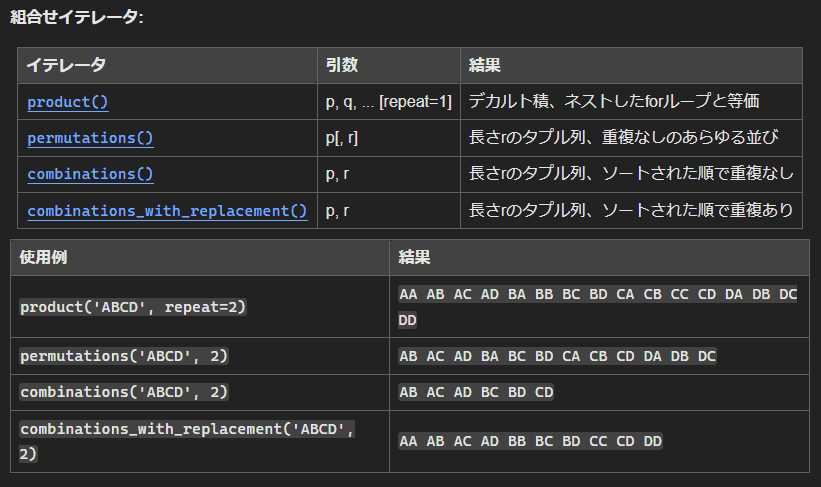
Reference: itertools --- Functions creating iterators for efficient looping — Python 3.12.1 documentation
Given the implementation of the string validation logic, it is entirely possible for the same character to appear consecutively, so in this case I needed to build the hash table using the Cartesian product.
Summary
This was the kind of problem where understanding the implementation alone was not enough; I still couldn’t solve it because I never reached the level of understanding needed to write the solver.
I need more practice.